
From mountain villages above canyons to turquoise rivers, wild horses and caves that breathe cold air in the middle of summer.
Bosnia and Herzegovina has plenty of places that are beautiful in the normal, easy-to-explain sense. There are old towns, mountain roads, riverside cafés and viewpoints where you take a photograph, send it to someone back home and receive the expected reply: “That looks lovely.” Then there are places that do something slightly different. If you are searching for places to visit in Bosnia that feel genuinely different from the usual European city break, the country gets interesting very quickly.
Part of the surprise comes from how quickly Bosnia changes. You can leave Sarajevo in the morning among Ottoman-era streets and Austro-Hungarian façades, climb into serious mountain country before lunch, and end the day somewhere in Herzegovina where the landscape has turned to pale limestone, vineyards and Mediterranean light. Drive west and the country changes again, becoming greener, wetter and dominated by rivers that seem almost suspiciously clear. Some of the most beautiful places in Bosnia are separated by only a few hours of driving, yet they can feel as though they belong to completely different countries.
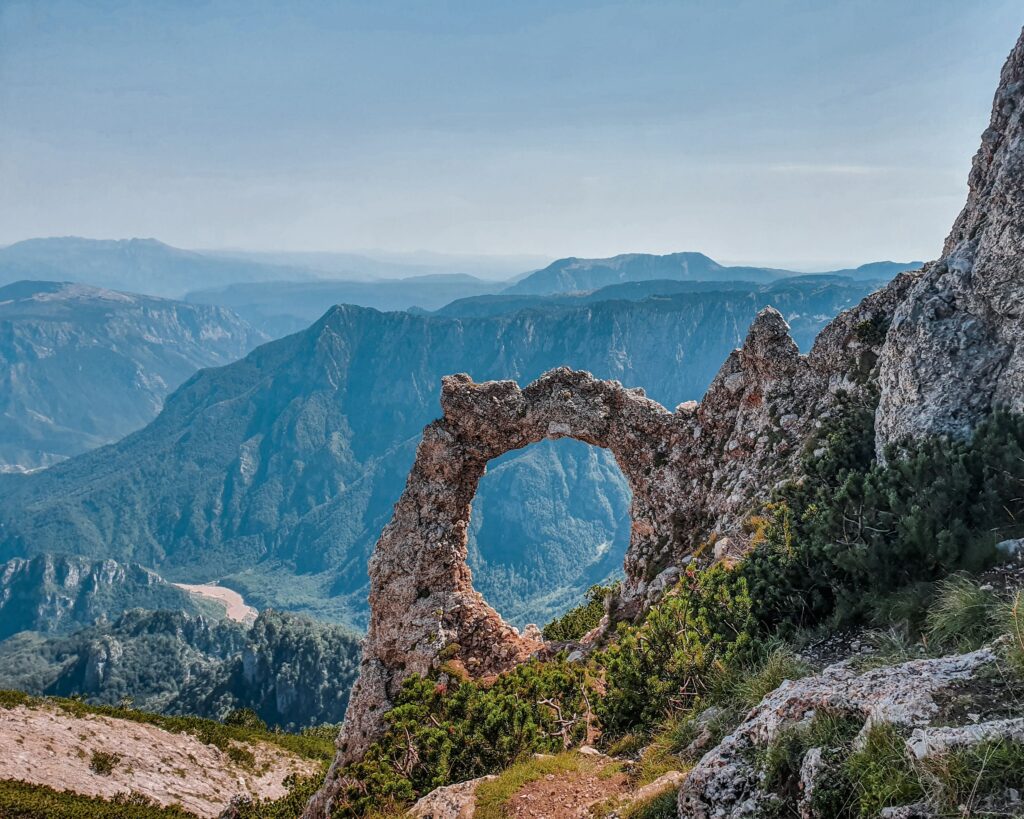
That variety is why so many unique places in Bosnia seem almost unreal. A village sits on a high plateau above a canyon deep enough to make you instinctively step back from the edge. Hundreds of horses roam freely across open grassland outside Livno. The Una turns shades of green and turquoise that make perfectly normal phone photographs look edited. On Čvrsnica, a natural stone arch stands around 2,000 metres above sea level, framing a mountain view as if somebody had deliberately built it there for hikers.
This list is not a ranking of the best places to visit in Bosnia. There is no sensible way to decide whether a primeval forest is more impressive than a river appearing from beneath a cliff, and Bosnians already have enough arguments without creating another one. Instead, think of these as ten places that show how strange, dramatic and unexpectedly varied the country can be. Some are easy day trips. Others require proper hiking shoes, patience, a suitable vehicle or a willingness to accept that Google Maps occasionally has a very optimistic understanding of Bosnian roads.
Most importantly, do not rush them. If you are deciding which things to see in Bosnia, leave enough space in the day for the road to take longer than expected, for coffee to become lunch, or for a local to tell you about another place that is “just nearby.” In Bosnian distance, “nearby” is a flexible scientific concept. Sometimes it means ten minutes. Sometimes it means forty-five minutes over a mountain pass.
Affiliate note: Some links in this article may be affiliate links. If you book through them, WanderBiH may earn a small commission at no extra cost to you.
If this list starts turning into an itinerary, our 7-day Bosnia road trip itinerary is a useful place to start building a route without trying to squeeze the whole country into one weekend.
1. Lukomir: A Village Above the Clouds
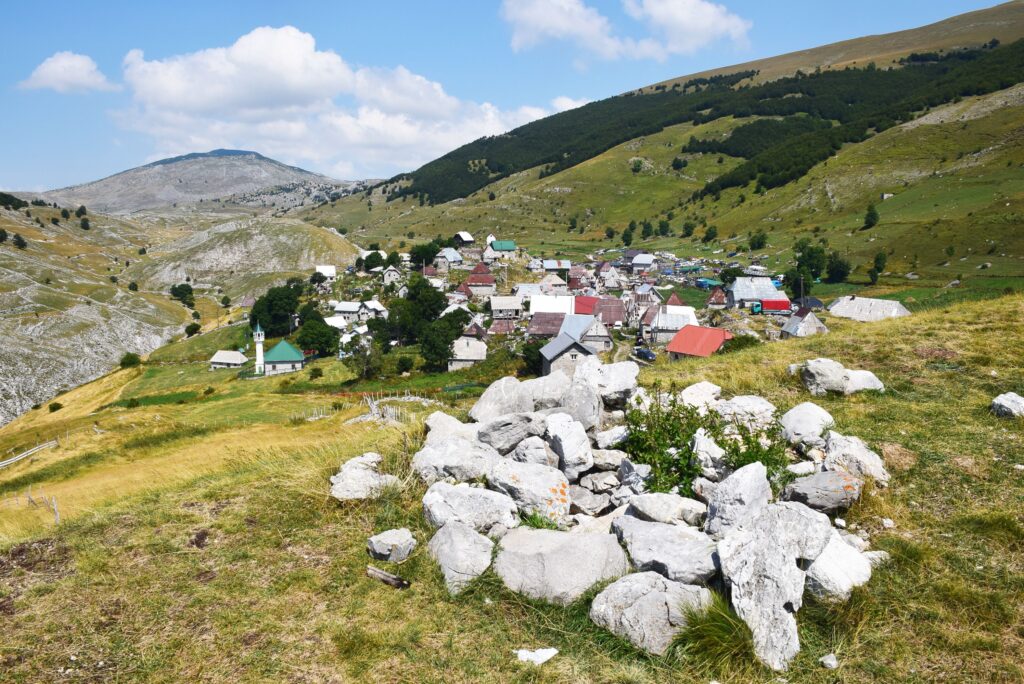
If somebody showed you a photograph of Lukomir without telling you where it was, you could easily place it somewhere in the Caucasus or a remote corner of the Alps. Stone houses sit close together on a high grassy plateau, sheep move across the surrounding slopes and the edge of the village seems to fall directly into the Rakitnica Canyon. The surprise is that all of this is only around fifty kilometres from Sarajevo. The city may be geographically close, but once you reach Bjelašnica and climb towards Lukomir, it feels very far away. For travellers who want mountain scenery without leaving the Sarajevo region, it is one of the most memorable places to visit in Bosnia.
Lukomir stands at roughly 1,500 metres above sea level and is one of the highest inhabited settlements in the country. Its traditional stone houses, steep roofs and compact layout developed for practical reasons: winters here are serious, winds can be strong and mountain life was never designed around what looks good in photographs. People still return to the village during the warmer months, and that matters because Lukomir is not an abandoned film set or an open-air museum. You are walking through a living place where people have families, animals and routines that existed long before tourism discovered the view. That mix of living culture and high-mountain scenery is why Lukomir belongs among the best places to visit in Bosnia for travellers who want more than a city break.
The moment that usually stays with visitors comes when you walk beyond the houses towards the edge above Rakitnica. The plateau ends dramatically and the canyon opens below you, with layers of mountains stretching into the distance. On a clear summer day the grass can be intensely green and the whole scene looks almost too carefully arranged. In changing weather it becomes even more dramatic, as clouds move quickly across Bjelašnica and parts of the landscape disappear and reappear within minutes. Even among unique places in Bosnia, Lukomir stands out because the landscape and village still make sense together rather than feeling like separate attractions.
That unpredictability is also why you should treat Lukomir as a mountain destination rather than a casual city attraction. Bring an extra layer even when Sarajevo is hot, check road conditions before driving and do not rely blindly on whichever shortcut your navigation app suggests. If you enjoy hiking, the village is even better when reached on foot as part of a proper mountain route. And if a local offers you coffee, homemade pie or cheese, do not worry too much about the schedule you created the night before. Some of the best travel experiences in Bosnia begin when the schedule stops working. Among the things to see in Bosnia, high mountain villages like this deserve a little more planning than a normal sightseeing stop.
If you are using Sarajevo as your base, our guide to things to do in Sarajevo can help you combine the city with the mountains around it. If you would rather avoid the mountain road yourself, you can take a guided 4×4 tour to Lukomir or hike to Lukomir with a local guide from Sarajevo.
2. The Wild Horses of Livno: Bosnia’s Accidental Western Movie
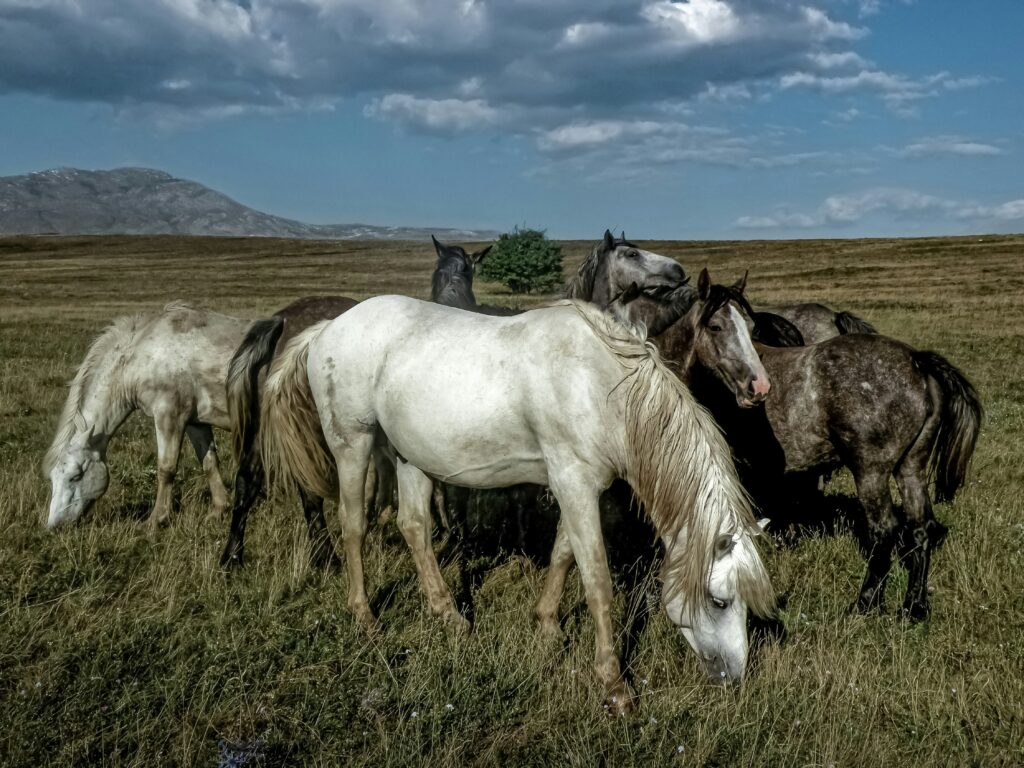
The Kruzi plateau above Livno can feel almost empty when you first arrive. There are wide grasslands, long ridgelines and very little to distract the eye. Then you notice movement in the distance. At first it may be a small group of horses. A few minutes later another herd appears over a rise, and suddenly the quiet Bosnian plateau starts to look like the opening scene of a Western film. Among the most unique places in Bosnia, this one works because nothing feels staged.
The famous Livno horses are usually described as wild, although feral or semi-wild is technically closer to the truth. Their ancestors were domestic working horses used by local farmers for agriculture and transport. As tractors and machinery gradually replaced animal labour, many horses were released and adapted to life on the plateau around Mount Cincar. Over time the population grew, and today large herds roam freely through the area. You may have seen photographs online, but the scale is difficult to understand until dozens of horses begin moving together across open ground in front of you.
What makes the experience special is not simply the number of animals. It is the combination of the horses and the landscape around them. There are no neat fences or staged viewing platforms, and the herds do not perform on a schedule. Sometimes they are close to the road, quietly grazing. Sometimes they are far across the plateau. At other times younger animals begin running, dust rises behind the herd and the whole scene becomes unexpectedly cinematic. For wildlife and open landscapes, it is easily one of the best places to visit in Bosnia.
That freedom does not mean visitors should treat the horses like a petting zoo. Keep a respectful distance, never chase them with a car or drone, and give mares with foals plenty of space. A local guide can be useful because the herds move and people who know the plateau usually have a better sense of where to look. Also, do not leave immediately after finding the horses. Livno itself, the surrounding karst landscape and the local cheese are worth your time. The horses may be why you came, but they do not need to be the only thing you remember. If you are collecting unusual things to see in Bosnia, free-roaming horses on an open mountain plateau are difficult to beat.
For more practical detail on where the herds roam, when to go and how to visit responsibly, read our complete guide to the wild horses of Livno.
3. Štrbački Buk: The Una River Showing Off
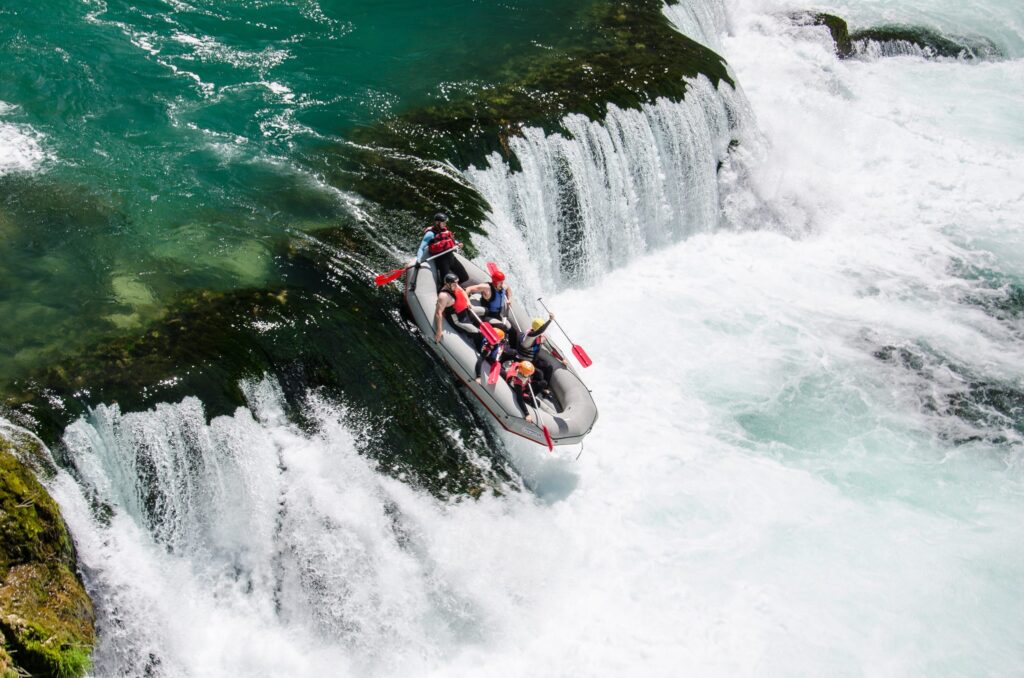
People from the Una region are not entirely objective about their river. Mention that another river might be more beautiful and the conversation can become surprisingly serious. Once you stand in front of Štrbački Buk, however, you begin to understand the loyalty. Here the Una spreads across a wide series of travertine steps and drops through dense green forest in layers of foaming water. It is less like a single waterfall and more like the river suddenly deciding to show you everything it can do at once. For travellers drawn to rivers and waterfalls, this is easily one of the best places to visit in Bosnia.
The colour is usually the first thing visitors talk about. Depending on the weather, season and recent rainfall, the Una can shift between deep green, blue-green and an almost unbelievable turquoise. When sunlight reaches clear water over pale limestone, ordinary photographs can look as though somebody has increased the saturation afterwards. The effect is especially striking when the surrounding vegetation is at its brightest in late spring and early summer. Even among the beautiful places in Bosnia, the Una has a colour palette of its own.
Štrbački Buk lies inside Una National Park, but the waterfall should not be treated as the only reason to visit the region. The park protects a much larger river landscape around the Una and Unac, and this is one of the best parts of Bosnia for rafting, kayaking, walking and simply spending time beside the water. If your itinerary allows it, stay in the Bihać area rather than attempting to turn the Una into a rushed tick on a long driving day. Western Bosnia works best when you slow down enough to notice how much of life here revolves around the river. For anyone deciding which things to see in Bosnia outside the major cities, the wider Una region deserves at least a full day.
For photography, earlier or later in the day usually gives you softer light and fewer people competing for the same viewpoint. Water levels also change the character of the falls, so the place may look different from the image that originally convinced you to visit. That is not a disadvantage. The Una does not exist to reproduce somebody else’s Instagram photograph, and part of the charm is seeing what version of the river you get on the day you arrive.
If you are based in Sarajevo and do not want to rent a car, a full-day guided trip to Štrbački Buk can combine the waterfall with Jajce, Pliva Lake and Travnik. It is a long day, but it removes the transport problem completely.
4. Prokoško Lake: Beautiful, Messy and Very Bosnian
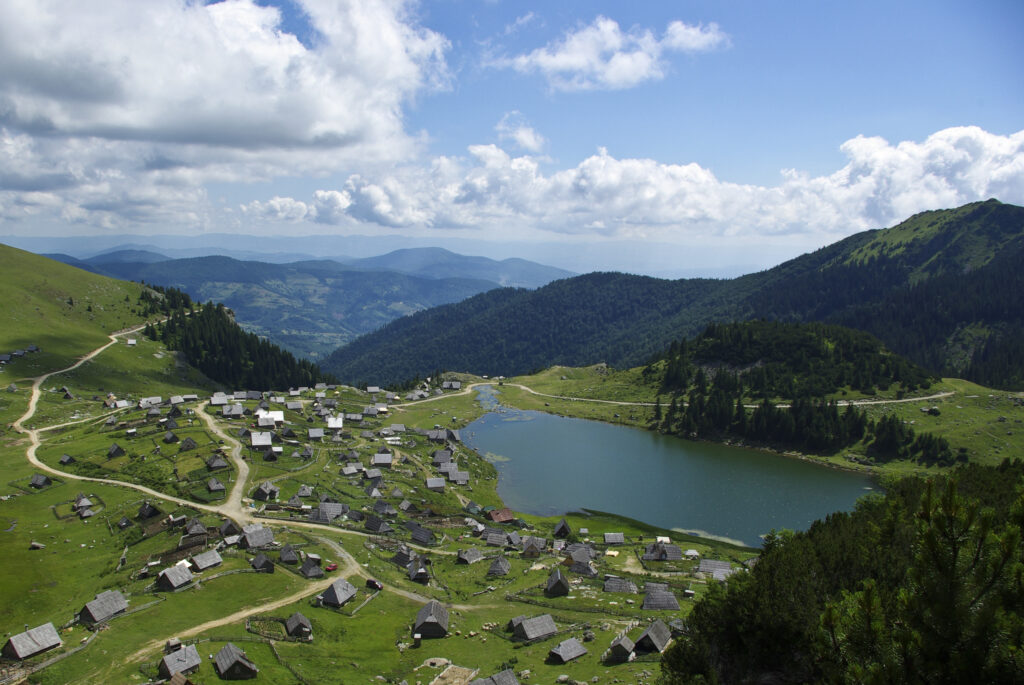
High on Vranica mountain above Fojnica, Prokoško Lake appears in the landscape like something from a folk story. A small glacial lake sits between green slopes while wooden and stone huts cluster around the water. Sheep graze nearby, smoke sometimes rises from chimneys and the scene can look almost too traditional to be real. It is one of those hidden gems in Bosnia that feels much farther from the cities than the map suggests.
Traditionally, the area around the lake was connected with seasonal shepherd life, and that history still shapes the atmosphere today. The simple buildings, grazing animals and open mountain terrain are much more important to the character of Prokoško than any single viewpoint. This is not a destination that needs a list of twelve activities. Walk around the lake, climb slightly above the settlement for a wider view, talk to people if the opportunity arises and eat something local when one of the small establishments is open. Cheese, kajmak, homemade bread and pie make more sense here than any elaborate menu ever could.
At the same time, Prokoško is a good example of why beautiful places in Bosnia should not be romanticised too much. The lake and its surroundings have faced environmental pressure, construction and the consequences of increasing visitor numbers. That does not make Prokoško less worth visiting. It means you should visit with a little more awareness: take your rubbish with you, stay on sensible routes and remember that the landscape is not a disposable background for photographs.
Road conditions can change, especially after poor weather, so check locally before driving and think realistically about the vehicle you are using. Mountain weather deserves the same respect. Under clear skies Prokoško looks peaceful and open; in fog it can become cold, disorienting and surprisingly dramatic. In both cases it is memorable, but only one version is ideal for arriving in light shoes with no jacket. For travellers deciding which things to see in Bosnia beyond the famous city breaks, Prokoško rewards a slower mountain day.
5. Hajdučka Vrata: A Stone Window at 2,000 Metres
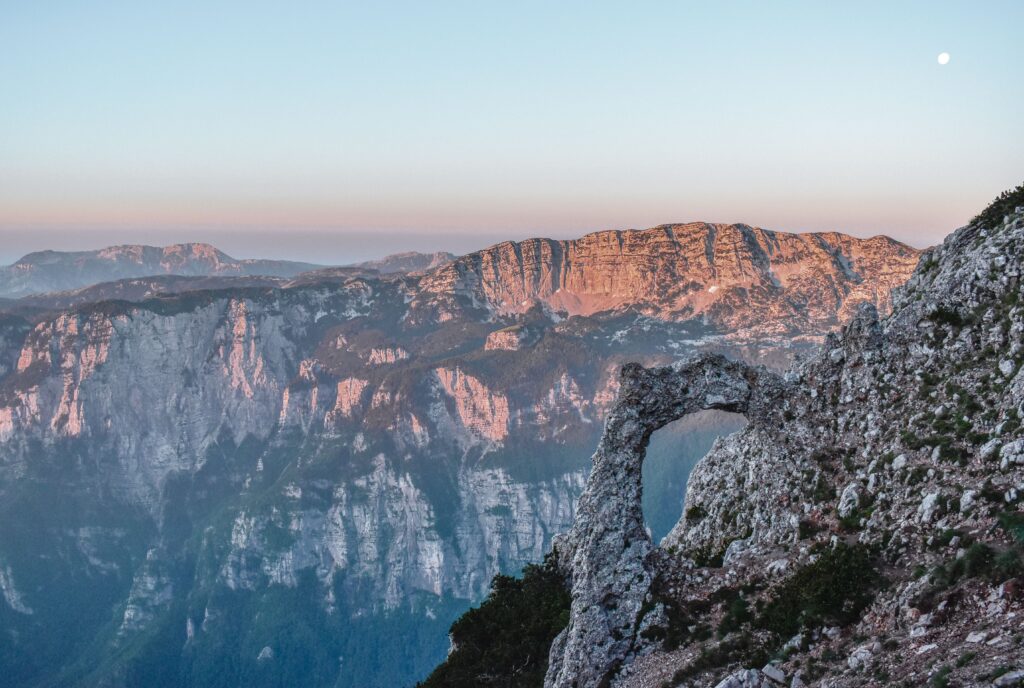
On Čvrsnica mountain, at around 2,000 metres above sea level, a natural limestone arch stands above the Herzegovinian landscape. Hajdučka Vrata has become one of the most recognisable hiking images in Bosnia and Herzegovina. If your idea of unique places in Bosnia involves earning the view rather than driving to it, this is one of the clearest examples. From the right angle, the rock forms a near-perfect frame around layers of distant mountain ridges, which explains why photographs from here often look as though somebody designed the entire scene for a travel campaign.
The famous photograph can make the arch look easy to reach. It is not. Unlike Blagaj or Kravica, this is not somewhere you park nearby, walk for ten minutes and order coffee afterwards. Reaching Hajdučka Vrata means hiking through proper mountain terrain, and the exact difficulty depends on your chosen route, conditions and experience. Good footwear, enough water, sun protection, layers and a realistic sense of your fitness are essential. If you are inexperienced in the mountains, going with someone who knows the route is a much better idea than treating a GPS line as a guarantee of safety.
The effort is exactly what makes the arrival so satisfying. After hours of forest, rock and open mountain, the arch suddenly appears in a place where it seems almost impossible that such a clean natural shape should exist. Step closer and the view through the opening reveals enormous mountain space beyond. It is easy to understand why people immediately reach for their phones, but it is worth spending a few minutes simply sitting there as well. You worked too hard to experience the entire moment through a screen.
Hajdučka Vrata should also be an introduction to Blidinje rather than the only thing you see in the area. Čvrsnica, Vran, Blidinje Lake, Masna Luka and the nearby stećci create one of the country’s richest mountain landscapes. Anyone making a list of things to see in Bosnia beyond the famous cities should give this region more than one photo stop. If your legs still work after the hike, there is a lot more to explore. For hikers, the wider Blidinje area is one of the best places to visit in Bosnia if you have several days rather than several hours.
6. Ramsko Lake: The Lake That Keeps Changing Shape
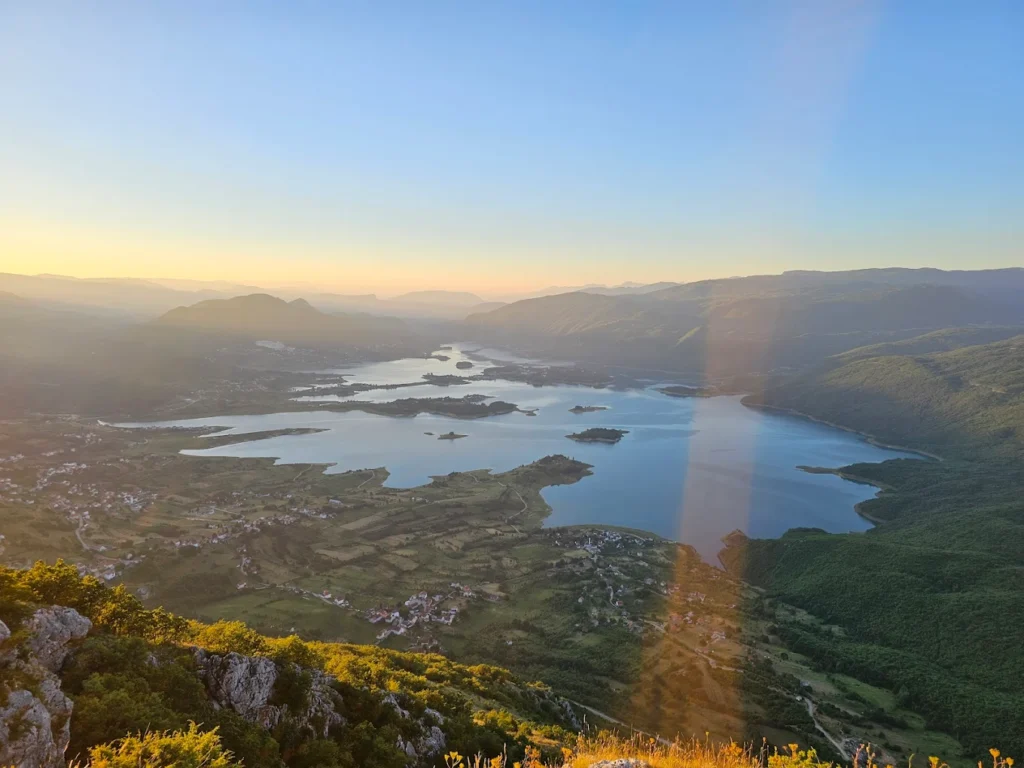
Ramsko Lake looks so naturally placed among the mountains that many first-time visitors assume it has always been there. In fact, it is an artificial reservoir created in the late 1960s. Somehow, the flooding of the valley produced one of the most photogenic landscapes in the country: long branches of blue water wind between hills, peninsulas reach into the lake and small islands appear to float beneath layers of mountain ridges. For anyone collecting beautiful places in Bosnia, Ramsko Lake deserves far more attention than it usually gets.
The lake’s shape is what makes it particularly unusual. From the shoreline you see calm water and quiet villages, but from higher ground the full geography becomes clear. Bays curve in unexpected directions, fields sit above the water on sloping ground and the Šćit peninsula projects into the lake with the Franciscan monastery at its centre. Water levels can change considerably during the year, which means Ramsko never has only one appearance. A photograph taken in spring may show a shoreline that looks quite different when you return later in the season. That shifting geography makes it one of the most beautiful places in Bosnia to photograph from above.
If you come for photography, resist the temptation to drive straight to the water. First find a higher viewpoint and look down across the lake. Morning can be especially calm, while late afternoon gives the surrounding hills warmer light. Autumn is another excellent time, when fields and forests introduce more colour into a landscape that can otherwise feel dominated by blue water and pale mountains. For foreign visitors, it can still feel like one of the hidden gems in Bosnia, especially outside the busiest summer weekends. If your list of things to see in Bosnia is dominated by famous cities, Ramsko Lake is a useful reminder to look beyond them.
Then go down to Šćit and spend some time walking around the monastery peninsula. The Franciscan presence in Rama is part of a much longer local history, and the setting is more interesting when you understand that the lake is not merely a scenic backdrop. Ramsko is also a very good place to practise the Bosnian art of doing less than planned. Sit beside the water, drink coffee, watch somebody fish and accept that you may not reach every point you saved on Google Maps. The lake will still be there tomorrow.
If Ramsko Lake is going on your route, our complete Ramsko Lake guide covers viewpoints, Šćit, access and what to do around the lake.
7. Vjetrenica Cave: Bosnia’s Underground World
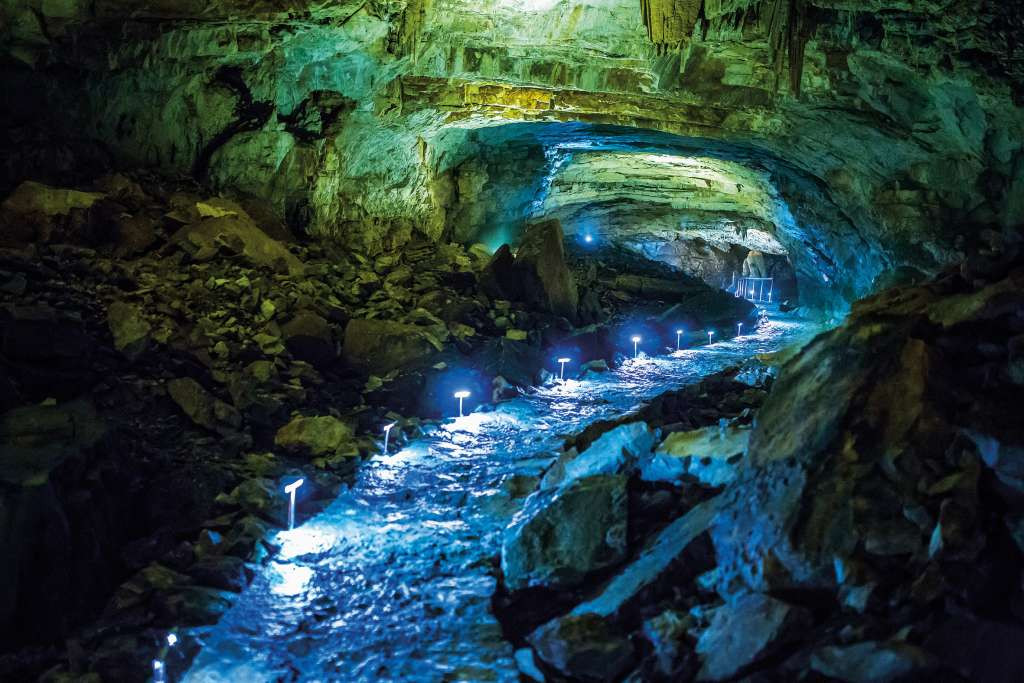
Southern Herzegovina is famous for sun, limestone and summer heat, which makes the entrance to Vjetrenica especially strange. Stand near the cave on a warm day and cold air rushes outward from the darkness. The name comes from the Bosnian word for wind, and the effect is immediate enough that no further explanation is really necessary. After hours outside in Herzegovina, it can feel as though somebody has opened the door to a giant natural refrigerator. If you are looking for unusual things to see in Bosnia, an underground ecosystem that literally blows cold air at you is a strong candidate.
Inside, the landscape changes completely. Passageways, pools and limestone formations replace the dry countryside above ground, while artificial lighting reveals just enough of the cave to remind you how much continues beyond the visitor route. Vjetrenica is not important only because it looks impressive. The cave is internationally significant for its underground biodiversity and was added to UNESCO’s World Heritage List in 2024, giving one of Bosnia’s lesser-known natural sites the global recognition it deserves. That combination of science and scenery keeps Vjetrenica among the more unusual hidden gems in Bosnia.
That scientific importance also makes the cave more interesting to visit. This is not simply a collection of stalactites with a souvenir shop at the end. Vjetrenica is an ecosystem shaped by darkness, water and isolation, with species adapted to conditions that would be impossible for most life above ground. The contrast with the bright, hot landscape outside makes the experience feel even more dramatic. It is also one of the most scientifically unique places in Bosnia, which is a better reason to visit than simply collecting another cave photograph.
Bring a light layer even in summer and combine the cave with a wider trip through eastern Herzegovina. Popovo Polje, Ravno and Trebinje create a very different atmosphere from Sarajevo or central Bosnia: more exposed stone, more vineyards and a stronger Mediterranean influence. If you have only seen the green mountains and river valleys of the north, this part of the country can feel like another Bosnia entirely.
If you are staying in Dubrovnik, a private day trip combining Vjetrenica Cave and Kravica Waterfalls is one of the easiest ways to visit without organising the cross-border transport yourself.
8. Perućica: A Forest That Was Here Before Your Itinerary
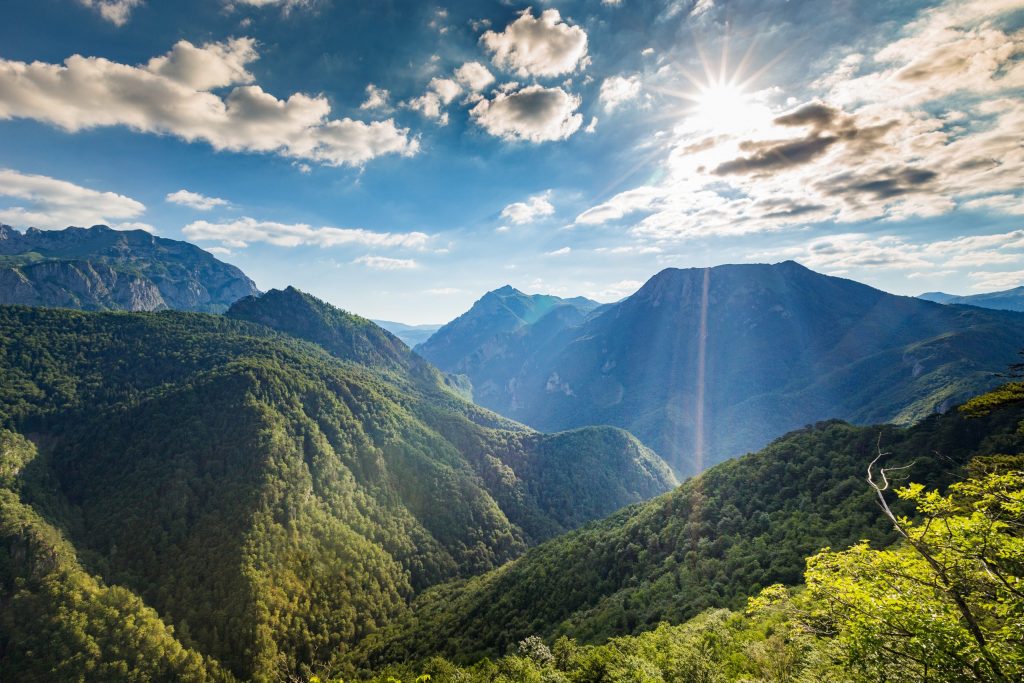
Bosnia has a lot of forest, but Perućica is not simply another place with many trees. It is a strictly protected primeval forest reserve inside Sutjeska National Park, surrounded by some of the country’s wildest mountain terrain. Huge trees rise from steep slopes, fallen trunks remain where nature puts them and new growth covers old wood rather than being cleared away. From the viewpoints above, the valley looks like a dense green sea with almost no obvious sign of human intervention. Among the most unique places in Bosnia, Perućica is unusual precisely because people have done so little to it.
That absence of human order is what gives Perućica its power. Modern European landscapes are usually shaped by roads, forestry, agriculture or settlement. Here the forest follows its own logic. Deep inside it, Skakavac waterfall drops through the vegetation while mountains including Maglić rise around the wider park. Standing above Perućica makes Bosnia suddenly feel much larger and much wilder than it appears on a map. For many first-time visitors, it is one of the hidden gems in Bosnia precisely because it feels so untouched.
The important practical point is that the strict reserve is not somewhere you simply enter because you feel adventurous. Access is controlled and visitors who go into the protected interior need authorised guidance from Sutjeska National Park. This is one of those rules worth respecting without trying to negotiate with it. An ecosystem that has survived for centuries without needing our opinions probably deserves a little space from us.
You can still experience the scale of the forest from recognised viewpoints such as Dragoš Sedlo, depending on current road and weather conditions. And if you have more time, Sutjeska offers much more than Perućica alone: mountain lakes, hiking routes, dramatic peaks and the historical landscape around Tjentište. The park rewards travellers who come prepared and stay longer than a quick afternoon. It is not the sort of place that enjoys being rushed. For serious nature travel, Sutjeska is one of the best places to visit in Bosnia, and Perućica is only one part of the reason.
If the idea of a primeval forest surprises you, our guide to 15 fascinating facts about Bosnia and Herzegovina has more examples of the country being stranger than first-time visitors expect. If you want to explore the wider Sutjeska area without organising mountain transport yourself, a guided 4WD and hiking tour from Foča combines Sutjeska, Trnovačko Lake and a viewpoint overlooking Perućica.
9. Blagaj: Where a River Comes Out of a Mountain
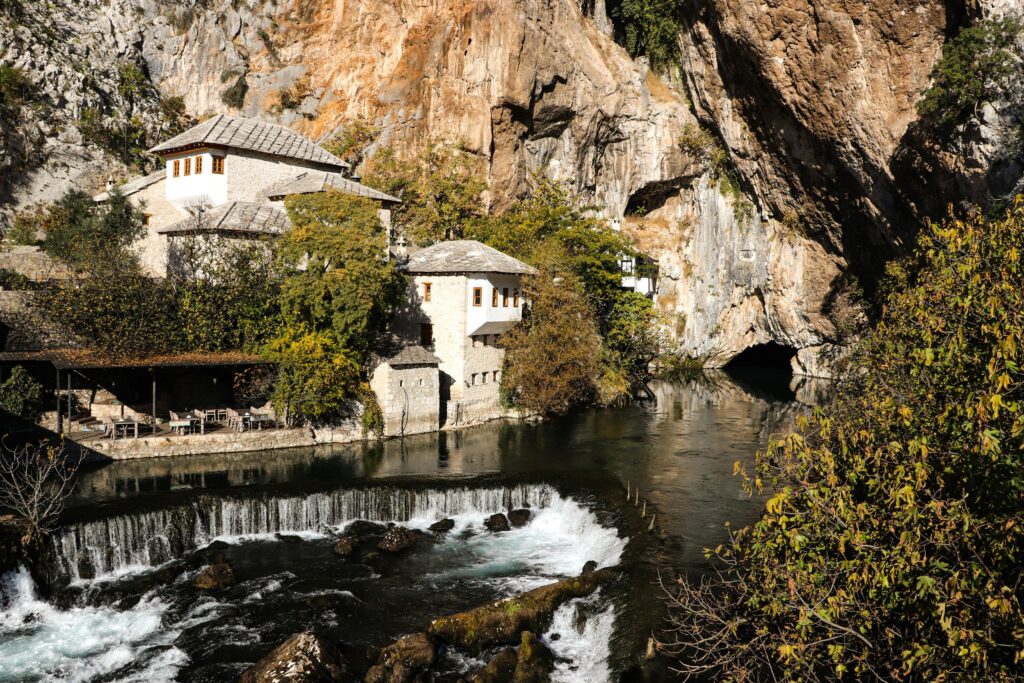
There are several things in Bosnia that locals accept as perfectly normal until a visitor points out how unusual they actually are. Blagaj is a good example. Beneath an enormous limestone cliff stands an old dervish tekke, and directly beside it a dark cave opens at the base of the rock. From that cave emerges the Buna River, already wide, clear and cold enough to look like a fully formed river from the moment you first see it. For culture, landscape and sheer visual drama in one stop, Blagaj is among the best places to visit in Bosnia.
The combination of water, cliff and architecture is what makes Blagaj so memorable. The tekke seems almost impossibly small beneath the vertical rock face, while the river immediately turns the space below into a line of gardens and restaurants. It is one of the most photographed scenes in Herzegovina, and the classic view from across the water deserves its popularity. Still, Blagaj becomes more interesting when you move beyond the photograph and spend time around the spring itself. Among the beautiful places in Bosnia, few combine architecture and geology as neatly as this.
Visit the tekke respectfully, remembering that it is a religious and cultural site rather than a decorative prop. Walk across the bridges, watch how the colour of the Buna changes with the light and, when local conditions allow, consider a short boat ride towards the cave at the source. The water remains remarkably cold even in summer, which is exactly what you want when Herzegovina is experiencing one of those afternoons when shade becomes the most valuable piece of real estate in the country.
If the tekke makes you curious about the country’s layered spiritual history, our guide to Bosnia’s religious heritage puts Blagaj into a much wider context.
Blagaj is close enough to Mostar that it is easy to combine the two, but avoid the common mistake of squeezing Mostar, Blagaj, Počitelj and Kravica into a race against the clock. You can technically see many places in one day. That does not mean you will experience any of them properly. Sit beside the Buna, order lunch and allow the river to ruin your schedule a little. That is usually the better story.
If you are staying in Mostar without a car, a guided Herzegovina day trip combining Blagaj, Počitelj and Kravica Waterfalls is an easy way to see the three without planning the transport yourself.
10. Kravica Waterfalls: Herzegovina’s Natural Amphitheatre
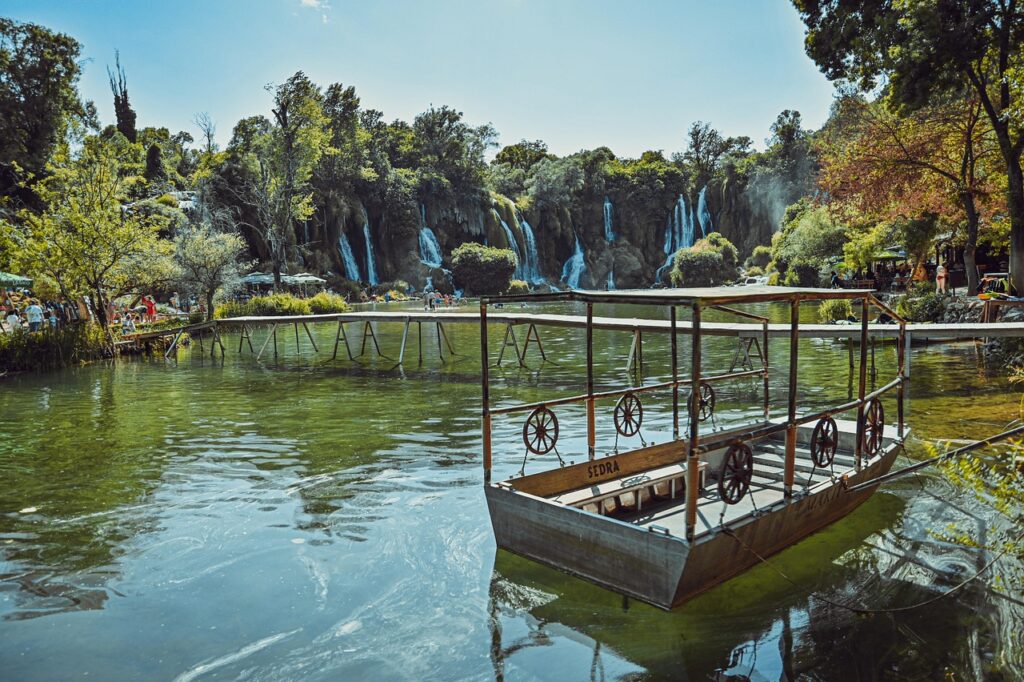
Aerial photographs of Kravica often look like they were taken in a tropical national park somewhere much farther south. The Trebižat River spreads across a broad semicircular edge and falls in dozens of separate streams into a wide pool below, with thick vegetation growing between the cascades. Instead of one narrow waterfall, Kravica forms something closer to a natural amphitheatre of moving water. It is one of the most photographed places to visit in Bosnia, and for once the popular photographs do not oversell the place.
The appearance changes with the season. After wetter periods the waterfall is louder, broader and more powerful, while lower summer water levels expose more rock and greenery. Neither version is the “correct” Kravica. They are simply different moods of the same place. If the exact photograph you saw online depends on a particular water level, remember that rivers have never shown much interest in maintaining consistency for travel influencers. It remains one of the most beautiful places in Bosnia in every season, just in a different way.
Kravica is popular, and there is no point pretending it is a secret. In summer it attracts visitors from Mostar, the Croatian coast and the wider region, especially in the middle of the day. Arriving early gives you a calmer experience, more comfortable temperatures and a much better chance of seeing the falls before the busiest period. Opening times, ticket prices and swimming rules can change, so check the official visitor information shortly before you go rather than relying on an old blog post or screenshot.
The wider Ljubuški area is worth exploring as well. Koćuša Waterfall, the Trebižat River and local cultural sites make it easy to build a full day rather than treating Kravica as a single photograph. Once you arrive, walk around and look at the falls from more than one angle. The famous wide view is impressive, but the scale becomes clearer when you get closer and hear the water. And if you visit at two o’clock on a Saturday in August and discover other tourists have had exactly the same idea, we sympathise. But this one is probably not Bosnia’s fault. That variety makes the Trebižat valley one of the more unique places in Bosnia for travellers who enjoy combining nature with short cultural stops.
For practical details on tickets, swimming and the best time to arrive, read our complete Kravica Waterfalls guide. If you are planning more time around the country’s rivers and lakes, our guide to wild swimming in Bosnia has more ideas beyond Kravica.
If you are staying on the Croatian coast, day trips from Dubrovnik to Mostar and Kravica Waterfalls can handle the transport and border crossing for you.
Why These Are Some of the Best Places to Visit in Bosnia
Yes. That is probably the strangest part. The reason these places to visit in Bosnia feel so surprising is that none of them needs much help from Photoshop. Lukomir really does sit above an enormous canyon. Horses really do roam freely across the plateau outside Livno. The Una really can turn that colour. Hajdučka Vrata really is waiting high on Čvrsnica after several hours of hiking, and the Buna really does appear from beneath a wall of limestone as a proper river.
What makes travelling through Bosnia and Herzegovina so interesting is not that the country has one spectacular landscape. It is that the landscape refuses to stay the same for very long. For travellers deciding which things to see in Bosnia, that variety is the real advantage. In a few hours you can move from dense forest to bare karst, from high mountain pasture to vineyards, and from cold rivers to towns where summer evenings feel almost Mediterranean. The cultural landscape changes with it: food, architecture, accents and everyday rhythms shift as you move from one region to another. That is also why so many hidden gems in Bosnia become memorable for reasons that have little to do with famous landmarks.
That variety also means you should resist trying to see everything in one trip. The most beautiful places in Bosnia are not improved by rushing between them. On paper, 140 kilometres does not look far. On a Bosnian mountain road, 140 kilometres can contain bends, roadworks, a slow truck, an unexpected viewpoint, a coffee stop and somebody telling you about another waterfall you apparently cannot leave the region without seeing. By the time coffee becomes lunch, your original itinerary may have become fiction.
If you have a week, choose a region and travel more slowly. When you are choosing among places to visit in Bosnia, geography matters more than the number of pins you have saved. In western Bosnia, Livno and the Una region work beautifully together. Around Sarajevo and central Bosnia, Lukomir and Prokoško deserve separate days rather than being squeezed between city attractions. In Herzegovina, Blidinje, Ramsko Lake, Blagaj, Kravica and Vjetrenica can become an excellent road trip if you give them enough time. For true wilderness, Sutjeska deserves more than a hurried visit on the way somewhere else.
And if the weather turns bad, do what people here do remarkably well: sit down, order coffee and complain about it for a while. Twenty minutes later the cloud may move, the light may change and the mountain you thought you had missed can suddenly appear again. Bosnia has a way of doing that. Just when you think you understand what the country looks like, it changes the view. The best things to see in Bosnia are often the ones that give you a reason to slow down rather than simply move on.
If you are ready to turn these hidden gems in Bosnia into an actual route, return to our 7-day Bosnia road trip itinerary and build outward from there. It is a much better strategy than trying to collect every pin in one exhausted week.